
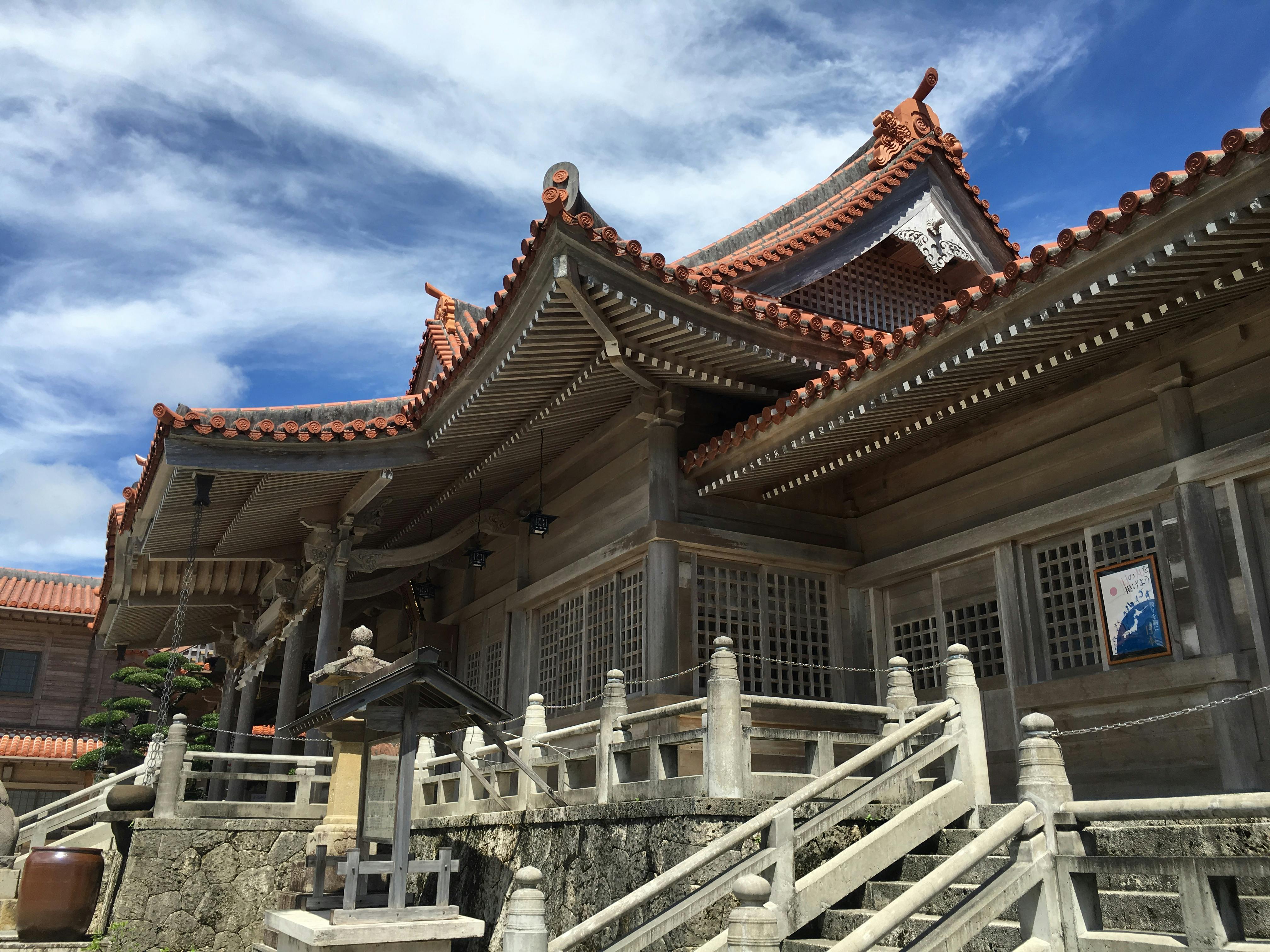
Okinawa History
Journey through the rich historical timeline of the independent Ryukyu Kingdom, from its early unification to its modern cultural renaissance. Our history modules examine the diplomatic navigation, maritime achievements, and structural challenges that shaped Okinawa. By tracing these events, participants understand how a legacy of trade and non-aggression created a resilient society dedicated to peaceful diplomacy.
Bridge of Nations
Before its annexation in 1879, Okinawa was the center of the independent Ryukyu Kingdom. For over four hundred years, this maritime state served as a vital trade link connecting China, Japan, Korea, and Southeast Asia. Lacking natural resources, the kingdom relied on the diplomatic intelligence and navigational skill of its people. Shuri Castle, the royal seat, became a hub of cultural exchange, where trade items were processed alongside new ideas, art forms, and administrative systems, creating a highly sophisticated and cosmopolitan society.
Despite geopolitical pressure, the Ryukyu Kingdom maintained its independence through diplomacy and non-aggression. This commitment to peace shaped a unique national identity that valued courtesy above military power. We explore these historical epochs to help participants understand the roots of Okinawa’s commitment to peace, showing how a heritage of diplomacy and resilience can guide our contemporary path of physical and spiritual training.
Chronicles of the Ryukyu Kingdom
The Three Polities
<p>Discover the early history of the Ryukyu islands when the main territory was divided into three warring polities: Chuzan, Hokuzan, and Nanzan. Each polity controlled its own fortified castles (gusuku) and engaged in independent trade and diplomatic relations with China. This period of intense rivalry and conflict ended in 1429 when Sho Hashi, the ruler of Chuzan, unified the three kingdoms and established the Sho Dynasty. This unification began a golden era of trade and cultural development, transforming the islands into a cohesive, prosperous kingdom.</p>
Maritime Power
<p>Learn about the Golden Age of the Ryukyu Kingdom, an era of unprecedented prosperity driven by its maritime trade network. Ryukyuan ships navigated the trade routes of East and Southeast Asia, transporting Chinese silk, Japanese copper, Southeast Asian spices, and Korean porcelain. This trade was not merely economic; it served as a channel for cultural exchange and diplomatic relations. The kingdom's ability to maintain peaceful relations with diverse nations during this period remains a testament to the diplomatic intelligence and maritime skill of its people.</p>
Modern Era
<p>Explore the complex challenges of the modern era, beginning with the Satsuma clan's invasion in 1609, which forced the kingdom into a dual-tributary relationship with Japan and China. We examine the kingdom's formal annexation by Japan in 1879, the cultural assimilation policies, the devastating Battle of Okinawa in 1945, and the post-war reconstruction. By studying these events, participants learn how the Okinawan people maintained their cultural identity and transformed historic suffering into an active commitment to peace and non-aggression.</p>
Historical Annexations & Treaties
Satsuma Invasion of 1609
In 1609, the Satsuma Domain of southern Kyushu invaded the Ryukyu Kingdom, subjugating the islands under Japanese feudal oversight while maintaining their external tributary relations with Ming China. This dual-vassalage created a unique cultural synthesis and forced Ryukyu diplomats to refine their pacifist defense strategies.
The 1879 Annexation & Ryukyu Domain
The Meiji government formally dissolved the Ryukyu Kingdom in 1879, incorporating it as Okinawa Prefecture. Despite intense cultural assimilation policies, Okinawans preserved their indigenous languages, ancestral rituals, and empty-hand self-defense techniques in secret.
Post-War Administration & Return
Following the Battle of Okinawa in 1945, the islands were placed under US military administration. Okinawan citizens campaigned for decades to return to peaceful civilian governance, culminating in the reversion of Okinawa to Japan in 1972.
Years of Sovereignty
<p>The independent Ryukyu Kingdom maintained a prosperous, peace-based maritime trade empire across East and Southeast Asia from Sho Hashi's unification in 1429 until its formal annexation in 1879.</p>
Key Milestones
Unification
The legendary ruler Sho Hashi successfully unifies the three warring polities of Hokuzan, Chuzan, and Nanzan, establishing Shuri Castle as the royal capital and founding the first Sho Dynasty of the Ryukyu Kingdom.
Satsuma Invasion
The Japanese Satsuma clan invades Okinawa, forcing the Ryukyu Kingdom into a vassal state relationship while maintaining its external trade tributary status with China, beginning a complex period of dual-subjugation.
Annexation
The Meiji government of Japan officially abolishes the autonomous Ryukyu Kingdom, deposing the last Ryukyuan king, Sho Tai, and establishing Okinawa Prefecture under direct administrative control of Tokyo.
“To study the history of the Ryukyu islands is to understand that our modern commitment to peace and non-aggression is not a passive choice, but a resilience forged through centuries of survival.”— Ryukyu Historians
Continue Exploration
Return to the main Okinawa program page to continue your detailed exploration of our unique training modules, or contact our admissions office directly to submit your application for the upcoming seasonal training cycle.