The Composite Bow
of the Steppe
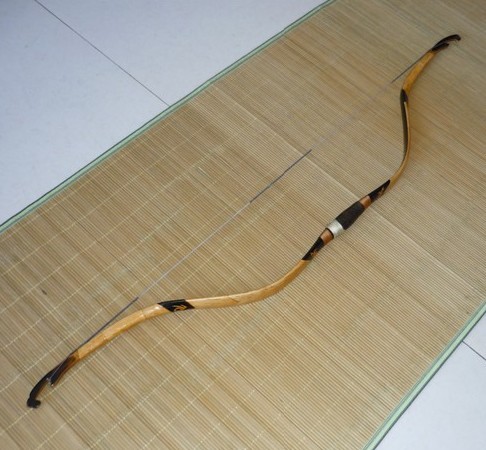
The composite bow of the Eurasian steppe represents perhaps the most sophisticated application of material science in the pre-industrial world. Far from a simple implement of wood, the steppe bow was a high-performance machine, engineered to maximize energy storage and projectile velocity within a compact frame.
For the modern bowyer and equipment enthusiast, understanding this weapon requires a deep dive into the synergistic relationship between organic materials and mechanical design.
The Tri-Laminate Architecture
The Wooden Core
Usually fashioned from maple, birch, or bamboo, the core serves as the structural framework. It provides the essential shape and a bonding surface for the reactive layers. It is not the primary source of power, but rather the stabilizer of the limb’s geometry.
The Horn Belly
Applied to the side of the bow facing the archer (the belly), slabs of water buffalo or ibex horn are utilized for their incredible compressive strength. When the bow is drawn, the horn resists being crushed, storing massive amounts of potential energy.
The Sinew Back
Animal tendons, dried and shredded into fibers, are applied to the back of the bow (the side facing the target). Sinew possesses a tensile strength comparable to modern carbon fiber. As the bow is drawn, the sinew stretches, pulling against the compression of the horn to create a powerful elastic snap upon release.
Geometry for the Mounted Warrior
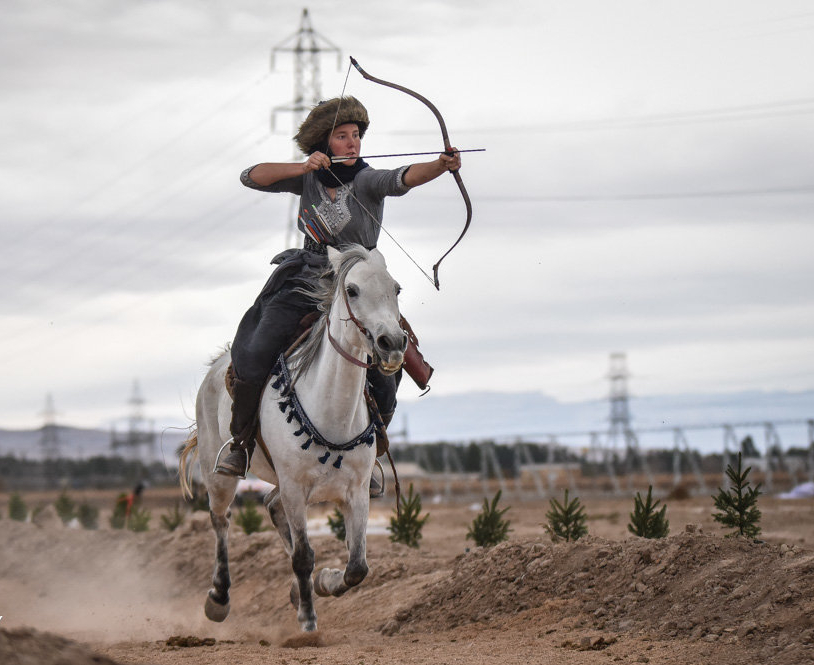
The compact profile of the steppe bow was not an aesthetic choice, but a tactical necessity. The constraints of mounted archery—shooting over a horse’s neck or backwards in a “Parthian shot”—demanded a weapon with a short total length.
To achieve high draw weights and long draw lengths in a short frame, bowyers utilized extreme reflex and recurve profiles. This geometry allows the bow to store more energy earlier in the draw cycle compared to a traditional longbow.
The Discipline of the Master Bowyer
The construction of a composite bow is a testament to extreme patience and technical mastery. The primary bonding agent—natural glue derived from fish bladders (ichthyocolla) or bovine hide—requires precise temperature and humidity control.
A master bowyer does not build a bow in days, but in seasons. After the application of the sinew layers, the bow must be “cured” in a controlled environment. This dehydration process can take anywhere from six months to two years.
In the hands of a skilled practitioner, the composite bow remains a symbol of the perfect alignment between biology, physics, and human discipline. It is a reminder that the most effective technologies are often those that work in harmony with the natural properties of the world around us.